Donate to the Trust

Invest

Findhorn, Nairn and Lossie Rivers Trust

What do we mean by ‘invest’?

These days, ‘invest’ usually implies a monetary commitment for a financial ‘return’.

But maintaining and supporting our watershed ecosystems and communities doesn’t always offer an obvious ‘return’ in the same way, even though they underpin the long-term viability of our businesses, developments, and the wider economic system.

Therefore, we see continuous investment in the living infrastructure of our natural, cultural and community assets, as well as the relationships and systems needed to maintain those, as being just as crucial as upkeeping ‘hard’ infrastructure such as our roads, bridges and energy system.

What would it look like to reconsider what a ‘return’ looks like and ‘invest’ in the future of these watersheds? What if the ‘return’ was a reliable supply of cold, clean water, enhanced and thriving biodiversity, flooding repair cost savings, or an increase in nature-positive job opportunities for local young people? By investing in the future of these watersheds, we mean investing in the long-term health, resilience and vitality of the ecosystems, communities, and local businesses which call this place home.

This is an invitation to be part of that work. Not to invest in fragments, but in the long-term health and resilience of an interconnected system.
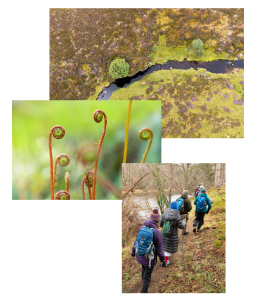
Collage of three photos - a river, curled ferns and people walking through a woodland

A watershed as an interconnected, living system

The rivers, land, communities and local economies of the Findhorn, Nairn and Lossie watersheds each have their own character and within them everything is connected. What happens upstream shapes what follows downstream. Watersheds provide natural units for ecological, social and economic renewal and together strengthen the wider system.

With the global challenges of climate breakdown and biodiversity loss, the impacts we are already facing on a local level, such as warming river temperature, more frequent flooding, drought, and wildfire, the decline of keystone species, and rural depopulation – cannot be solved through isolated projects alone.

They require coordination, trust, and long-term commitment at the scale of an entire landscape.

Our Approach

Our Watershed Finance Strategy supports an approach which attracts and stewards a blend of public, private and philanthropic investment while protecting ecological and cultural integrity. It is based on the idea that nature recovery is not only about planting trees or restoring rivers. It is also about transforming our human relationships with the places we live and work.

We describe this as watershed finance because it reflects a more integrated approach than the more widely used term of “nature finance”. This is investment that supports living systems, relationships and shared stewardship rather than extractive returns.

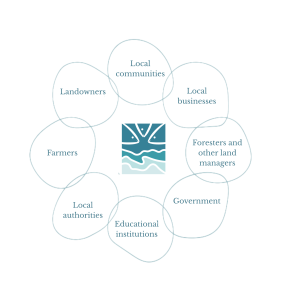
Our small team at FNLRT works closely with landowners, land managers, farmers, foresters, communities, businesses, local authorities and other river users. These long-held relationships allow us to do what no other single organisation, landholding or funder can do alone – align effort, blend funding and steward long term change across the landscape.

Our strength lies in these long-held relationships, deep knowledge of place and an ability to work at multi-watershed-scale across boundaries such as land ownership, sectors, and interests.

Green graphic showing the FNLRT logo in the centre, surrounded by circles containing names of key stakeholders - localk communities, local businesses, foresters and other land managers, government, educational institutions, local authorities, farmers, landowners.

No single organisation can deliver this alone

We invite partners to play a meaningful role in the future of this place through investment, collaboration and long-term partnership.

There are many ways to engage, from supporting specific initiatives to investing in multi-year partnerships. All contribute to a shared commitment to this place and its future.

We work with partners to address shared challenges such as those relating to water stewardship, biodiversity enhancement, climate resilience and social co-benefits.

From local businesses to corporates to philanthropists, we’d love to hear from you.

We use third-party cookies to personalise content and analyse site traffic.

Learn more